AI Automation Services for Growing US Businesses: From Pilot to Production
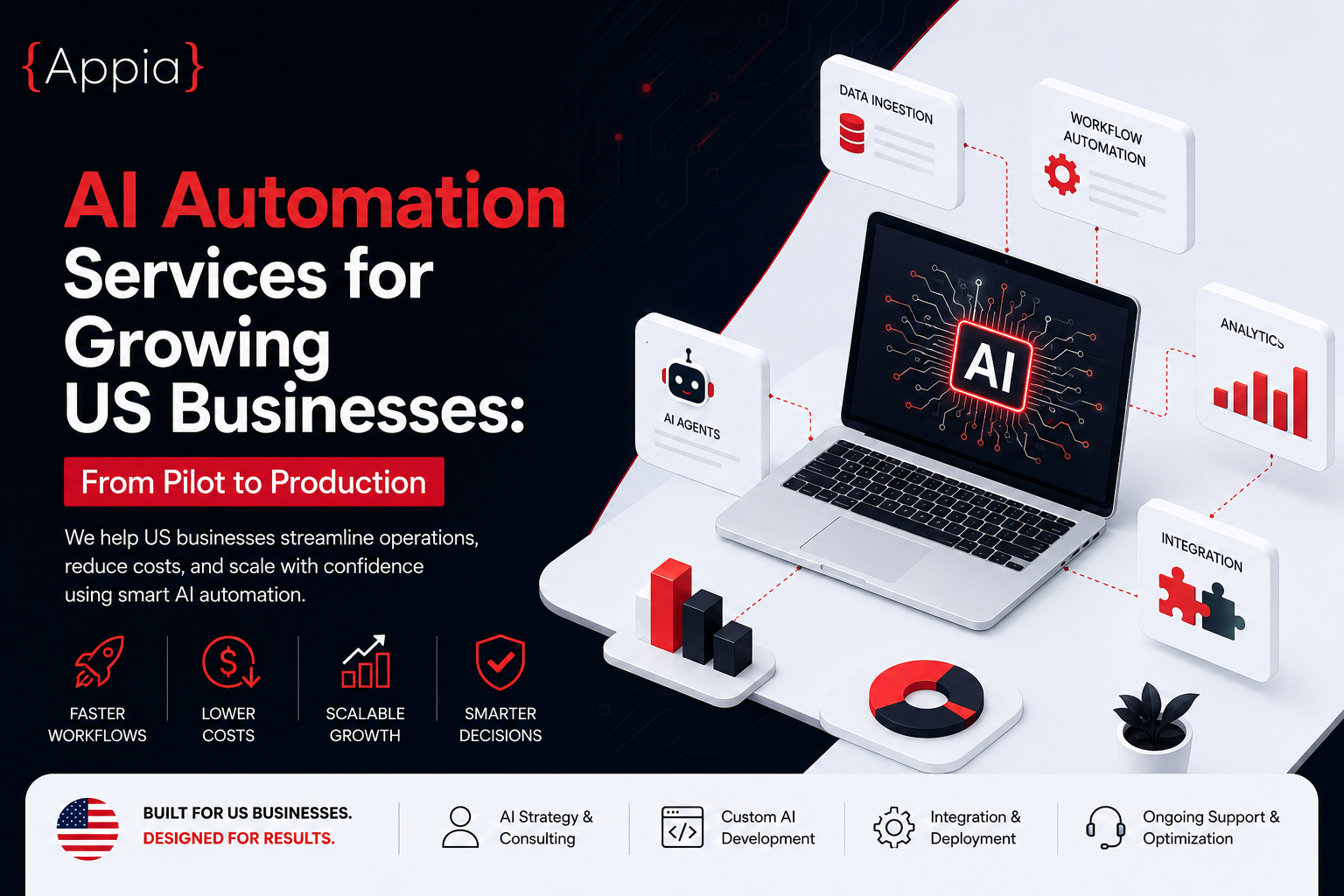
For most US operations and product teams evaluating AI automation, the starting question isn't which model to use -- it's which processes are actually a good fit. This is the practical version of that conversation.
Key takeaways
- AI automation earns its cost on tasks with variable inputs, multi-system dependencies, or a judgment step -- not on fixed, rule-based processes RPA already handles well.
- The fastest wins cluster around document/ticket triage, cross-system reconciliation, and research or drafting support.
- The gap between a working pilot and a production rollout is almost always governance, not model performance.
- Engagements fit three shapes: project delivery, a managed pod, or embedded capacity added to an existing team.
- A Pilot -> Production -> Compound rhythm keeps the second and third automation project cheaper than the first.
AI automation is not "add a chatbot"
For most US operations and product teams evaluating AI automation, the starting question isn't "which model" -- it's "which of our processes are actually a good fit." AI automation is the combination of AI agents, retrieval-augmented generation (RAG), and workflow design, applied to tasks that traditional RPA can't handle because the inputs are unstructured or the right next step depends on judgment.
Classic RPA is still the better tool for fixed, rule-based processes -- invoice matching against a known format, data entry between two systems with stable schemas. AI automation earns its cost when the task has variable inputs (support tickets, contracts, emails), spans multiple systems, or needs a decision that a fixed script can't encode.
Where AI automation pays off first
The fastest wins for US teams tend to cluster around a few patterns:
- Document and ticket triage -- classifying, routing, and drafting first-pass responses for support tickets, claims, or applications
- Data reconciliation across systems -- catching and resolving mismatches between a CRM, ERP, and billing system that used to require a person cross-referencing screens
- Research and drafting support -- pulling relevant context from internal knowledge bases via RAG to draft a first version of a report, proposal, or response for a human to review
None of these require replacing a whole department. They start as one workflow, with a human still reviewing output, and expand once the pattern proves reliable.
Governance isn't optional at production scale
The gap between a working pilot and a production system that a compliance or security team will sign off on is almost always governance, not model performance. For US enterprise buyers in particular, that means:
- Clear audit logs of every action an agent takes and why
- Defined approval gates for anything irreversible or costly
- Data handling that respects existing access controls -- an agent shouldn't have broader system access than the human role it's supporting
Teams that skip this step usually get a great demo and a stalled rollout once security review starts asking questions.
Three engagement models
- Project delivery -- a fixed-scope build, from a defined pilot workflow through a production handoff
- Managed pod -- a dedicated team that owns AI automation as an ongoing capability, adding new workflows over time
- Embedded capacity -- engineers who plug into your existing team when you need AI/ML skill you don't have in-house yet, without a full hire
Pilot, Production, Compound
We run every engagement through the same three stages:
- Pilot -- one workflow, real (not synthetic) data, a human reviewing every output
- Production -- the workflow runs with logging, guardrails, and a named owner on your side
- Compound -- the architecture (tool access patterns, logging, approval flows) extends to the next workflow instead of starting over
This keeps the second and third automation project cheaper and faster than the first -- the governance work isn't rebuilt each time.
Where to start the conversation
If you're comparing AI automation partners, the most useful first step is picking one real workflow and scoping what a supervised pilot would actually look like, not a general strategy deck. Talk to our team about scoping a pilot for a specific process.
FAQs
RPA follows a fixed script and works best for stable, rule-based processes. AI automation applies AI agents and RAG to tasks with variable inputs or a decision step a fixed script can't handle.