
AI and Software Development in New York: A Compliance-Ready Guide for NYC Businesses (2026)
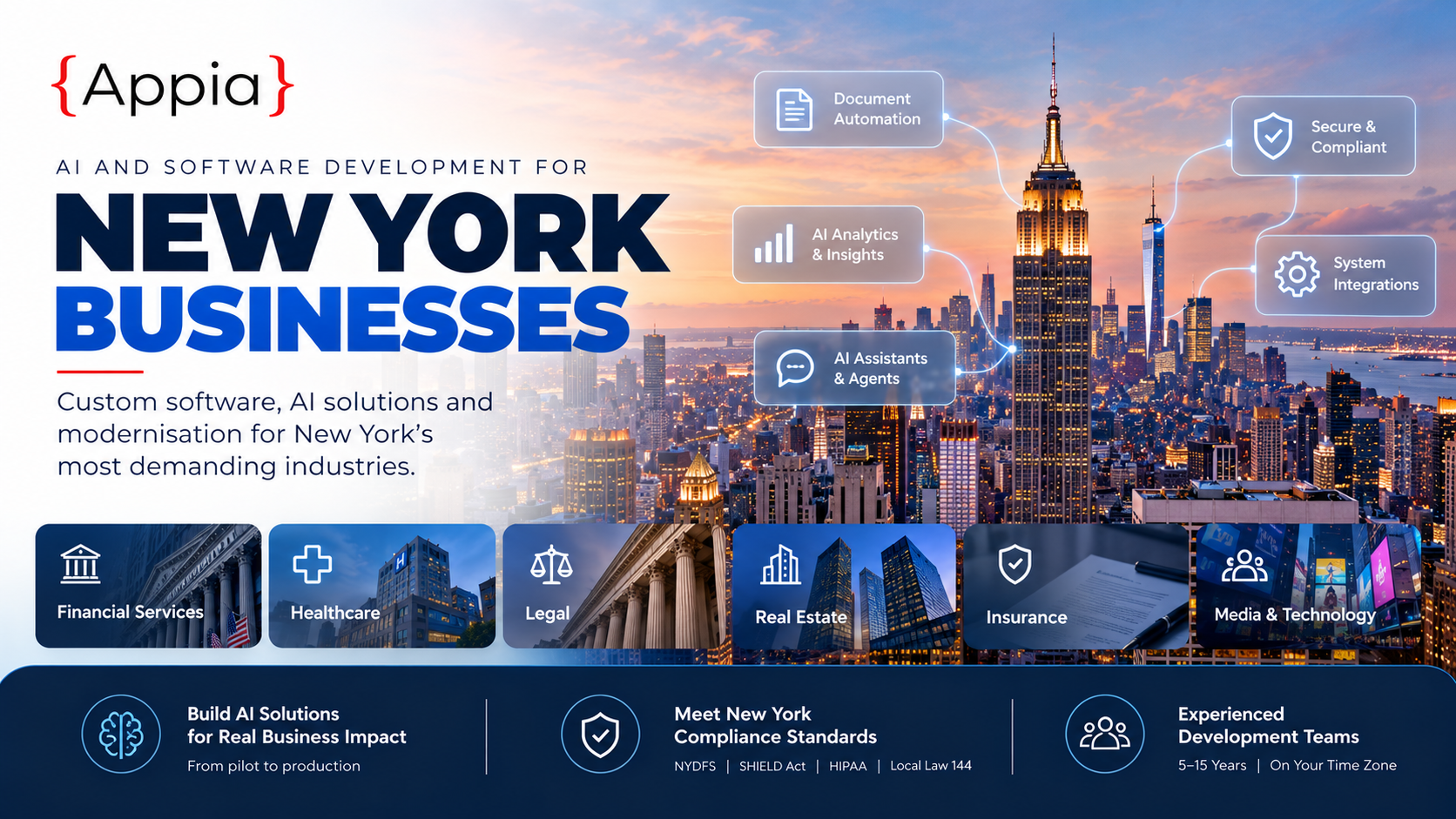
New York is home to the country's densest concentration of financial services, insurance, media, healthcare, legal and real estate firms, and almost all of them are under pressure to ship AI features and modernise legacy systems. They also face demanding rules: NYDFS cybersecurity requirements, the SHIELD Act, and NYC's law on automated hiring tools. This guide explains how New York businesses can build AI and software quickly without creating compliance risk.
Key takeaways
- Start with high-volume, document-heavy workflows: onboarding, claims, contract review, reporting and support.
- NYDFS Part 500 now requires broad MFA, asset inventories and third-party service provider oversight.
- The SHIELD Act requires reasonable safeguards and notifying affected New Yorkers within 30 days of discovering a breach.
- AI used in NYC hiring decisions needs an annual independent bias audit and candidate notice under Local Law 144.
- Choose a partner that can pass your vendor security review, not just build a demo.
What is AI and software development for New York businesses?
AI and software development for New York businesses means building custom platforms, integrations and AI features, such as document automation, assistants, agents and analytics, that fit the strict security and privacy expectations of New York's financial, healthcare, legal and media sectors. The goal is not a demo. It is production software that passes vendor risk review and delivers measurable results.
If you are planning an AI initiative or modernisation project, book a free scoping call with Appia Consultancy Services.
Why New York companies are accelerating AI and modernisation
- Competitive pressure in financial services. Banks, asset managers, insurers and fintechs are using AI to speed up onboarding, research, underwriting and client service.
- Document-heavy industries. Law firms, real estate, healthcare and insurance handle huge volumes of contracts, leases, claims and records that AI can classify, extract and summarise.
- Legacy systems. Many established NYC firms still run core workflows on ageing platforms that slow down every new product launch.
- Talent costs. Senior engineering and AI talent in New York is expensive and competitive, so many firms combine a small internal team with partner capacity.
High-ROI AI use cases for New York businesses
Client onboarding and KYC
Extract and verify data from identity documents, corporate filings and forms, flag exceptions, and pre-fill your CRM or onboarding system, with a human reviewer approving each file.
Insurance claims and underwriting intake
Classify incoming documents, extract key fields, check completeness and route cases to the right adjuster, cutting manual triage time.
Contract, lease and policy review
Retrieval-augmented generation (RAG) tools that summarise clauses, compare against standard terms and highlight risks, with citations back to the source document.
Research and reporting
AI assistants that pull data from internal systems and filings to draft reports, investment memos and client updates for analysts to review.
Customer and employee support
Assistants that answer common questions from your knowledge base, handle routine requests and hand off to people with full context.
Learn how we build these systems on our data and AI services page.
New York compliance your AI and software partner must understand
NYDFS Cybersecurity Regulation (23 NYCRR Part 500)
Banks, insurers and other NYDFS-regulated entities must run a risk-based cybersecurity program. The amended regulation's final requirements took effect on November 1, 2025, including expanded multi-factor authentication and written policies for a complete asset inventory. Regulated entities must also manage third-party service provider risk, so vendors with access to their systems or nonpublic information are expected to meet contractual security requirements such as MFA, encryption, access controls and incident notification.
The SHIELD Act
New York's SHIELD Act requires any business holding New York residents' private information to maintain reasonable administrative, technical and physical safeguards, wherever the business is located. Amendments signed in December 2024 require notifying affected New York residents within 30 days of discovering a breach and add NYDFS to the regulators that must be notified. Build logging, encryption and incident response into the system from the start.
NYC Local Law 144 (AI in hiring)
If you use an automated employment decision tool to substantially assist hiring or promotion decisions for NYC roles, Local Law 144 requires an independent bias audit within one year before use, a public summary of the results, and advance notice to candidates. Enforcement began on July 5, 2023. HR tech and recruiting products serving NYC employers should be designed for auditability.
Sector rules
Healthcare projects must meet HIPAA. Broker-dealers and investment advisers face SEC and FINRA expectations on recordkeeping and supervision, which affect how AI-generated communications are stored and reviewed.
Building AI that passes vendor risk review
New York buyers should expect these controls from any AI or software partner:
- Data minimisation: only the data each workflow needs, with sensitive fields masked or excluded.
- Access control: MFA, least-privilege access and separate environments for development, testing and production.
- Model and vendor choices: clear documentation of which AI models and cloud services process your data, and under what terms.
- Evaluation: accuracy tested on real, representative cases before launch, with ongoing monitoring afterwards.
- Human in the loop: human approval for decisions affecting customers, money, health or employment.
- Audit trail: logs of inputs, outputs and approvals, so you can answer regulators and auditors.
How to choose an AI and software development partner in New York
- Have your engineers shipped production AI systems, and can we meet the people who will work on our project?
- Do you have experience in financial services, insurance, healthcare or legal workflows?
- Can you complete our security questionnaire and meet our contractual security requirements?
- How do you evaluate AI quality, and what happens when the model is uncertain?
- How do you support Eastern Time stand-ups, reviews and incident response?
- Who owns the code, prompts, data pipelines and cloud accounts?
- What documentation, training and support do we get after launch?
How Appia Consultancy Services works with New York teams
Appia Consultancy Services LLC is a US software development and IT consultancy headquartered in Austin, Texas, working remotely with clients across New York and the rest of the country. Our in-house developers have 5–15 years of experience across full-stack development, cloud and DevOps, data and AI, enterprise systems, and QA, with deep experience in healthcare and fintech. We structure every engagement around your time zone and tools, and follow five stages:
- Consultation: goals, workflows, data and compliance constraints.
- Solution and launch plan: architecture, security approach, milestones and estimate.
- Build, validate and deploy: short delivery cycles with Eastern Time demos and evaluation against real cases.
- Docs, training and support: documentation and handover your team and auditors can use.
- Continuous improvement: monitoring, model updates and new use cases.
Next step
New York companies win with AI when they start with one high-value workflow and build it to production standards from day one. Get a free scoping call and we will help you pick the right use case, map your compliance requirements and plan a pilot. For more on scaling AI, read AI automation services: from pilot to production.
FAQs
Look for senior engineers who have shipped production AI, not just prototypes; experience in your industry; a clear discovery and evaluation process; and the security posture to pass your vendor risk review. Ask how they handle data access, model selection, testing, monitoring and documentation.
Sources
- Hogan Lovells — NYDFS final set of cybersecurity requirements under amended Part 500 take effect November 1, 2025
- Sidley — NYDFS clarifies expectations for third-party cybersecurity risks
- Inside Privacy (Covington) — New York adopts amendment to the state data breach notification law
- Office of the New York State Comptroller — Enforcement of Local Law 144: Automated Employment Decision Tools
- Perkins Coie — NYC adopts final rules for law governing automated employment decision tools