
Software Development Company in Texas: How to Choose an IT Partner in Austin, Dallas, and Houston (2026)
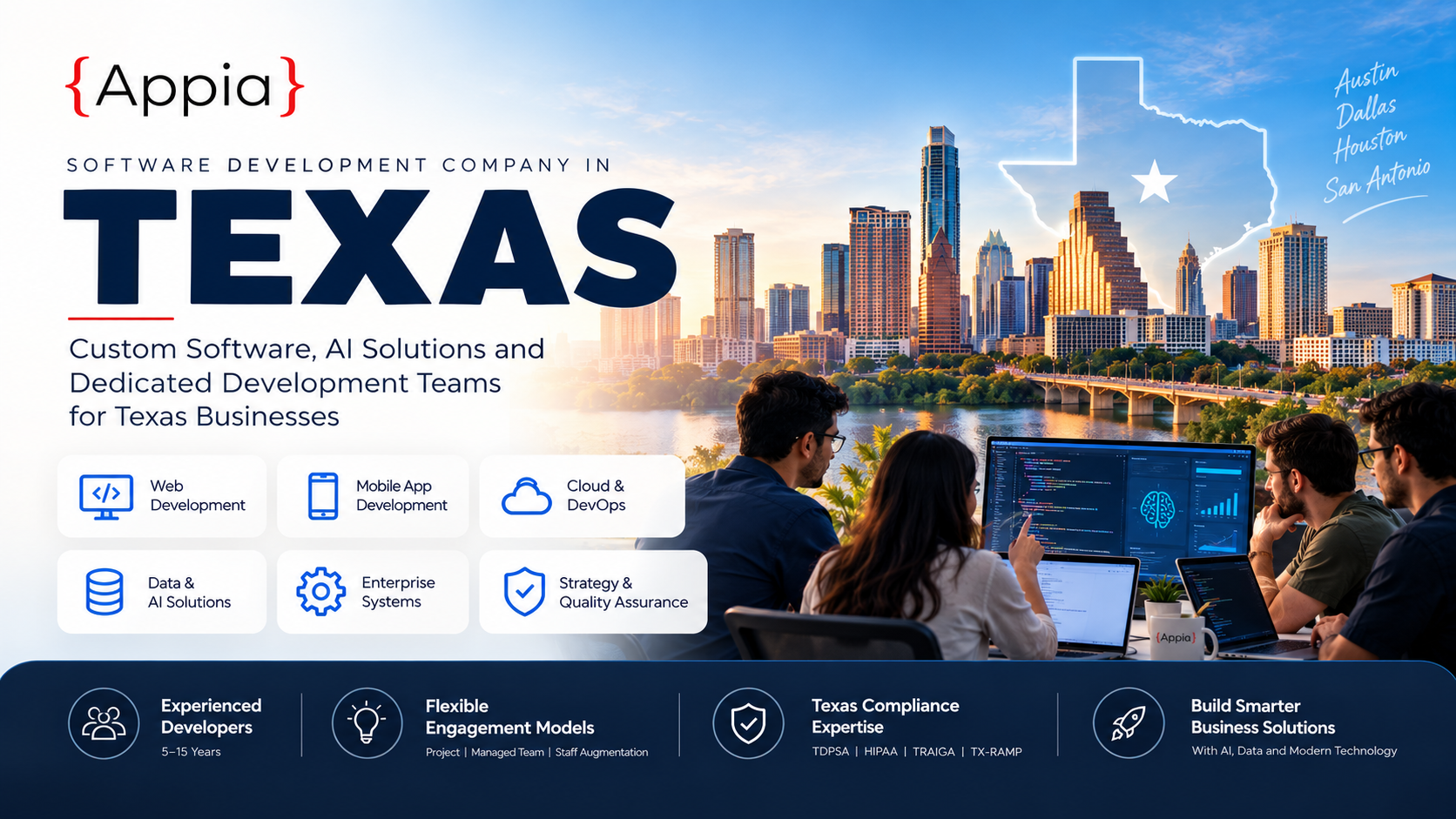
From Austin's software and semiconductor corridor to Dallas fintech, Houston energy and healthcare, and San Antonio's cybersecurity cluster, Texas companies are building more software than ever and competing hard for engineers. Choosing a software development company in Texas is no longer just about rates. It is about senior talent, Central Time collaboration, and delivery that respects Texas privacy and AI laws. This guide gives you a practical framework to decide.
Key takeaways
- Pick the engagement model (fixed-scope project, managed team, or staff augmentation) before comparing vendors.
- Texas privacy law (TDPSA) has applied since July 2024; Texas's AI law (TRAIGA) took effect January 1, 2026.
- Industry context matters: energy in Houston, fintech and banking in Dallas, software and semiconductors in Austin, healthcare statewide.
- Ask who will actually write the code, and how senior they are, before you sign.
- Insist on milestones, weekly demos, and full ownership of code, cloud accounts and documentation.
What does a software development company in Texas do?
A software development company in Texas designs, builds, tests and maintains custom software for Texas businesses: web platforms, mobile apps, cloud infrastructure, data pipelines, AI features and enterprise system integrations. The best partners also provide flexible engineering capacity, so you can add senior developers inside your own team when hiring is too slow.
If you want a fast answer: choose your engagement model first, check industry and compliance experience second, and compare price last. If you would like a second opinion on scope, book a free scoping call with Appia Consultancy Services.
Why Texas companies are investing in custom software
Texas has become one of the most important technology markets in the US, and each metro has its own demand profile:
- Austin: SaaS, semiconductors, hardware and fast-growing startups that need product engineering and scale-ready cloud architecture.
- Dallas–Fort Worth: banking, fintech, insurance, telecom and corporate headquarters that need secure enterprise systems and data platforms.
- Houston: energy, petrochemicals, logistics and the Texas Medical Center, where operational data, field apps and healthcare software are critical.
- San Antonio: cybersecurity, defense, healthcare and financial services with strong security and compliance expectations.
Across all of them, the same pressure applies: experienced engineers are hard to hire, and roadmaps slip while recruiting catches up.
Core software and IT services Texas businesses buy
Full-stack web development
Customer portals, marketplaces, SaaS products and internal tools built on modern stacks such as React, Next.js, Node.js, Python and .NET. See full-stack and web development.
Mobile app development
iOS, Android and cross-platform apps for field teams, patients, customers and drivers. Offline support matters for energy, construction and logistics use cases. See mobile app development.
Cloud and DevOps
Cloud migration, infrastructure as code, CI/CD pipelines, monitoring and cost optimisation on AWS, Azure and Google Cloud. See cloud and DevOps services.
Data and AI
Data pipelines, warehousing, analytics, machine learning and generative AI features such as RAG assistants, agents and workflow automation. See data and AI services.
Enterprise systems
Implementation and integration of platforms such as Microsoft Dynamics 365, Odoo, Zoho and SAP, connected to the rest of your stack. See enterprise systems.
Strategy and quality assurance
Technical strategy, architecture reviews, manual and automated testing, and release quality. See strategy and QA.
Engagement models compared
The engagement model decides who owns delivery risk, so choose it before you compare vendors:
- Fixed-scope project: best for well-defined builds such as an MVP, integration or redesign. The partner owns delivery against agreed milestones. Changes go through a change request.
- Managed team: best for ongoing product development. A cross-functional team is accountable for outcomes each sprint, with flexibility to reprioritise.
- Staff augmentation: best when you already have strong engineering leadership. Senior developers join your team and work in your processes and tools. You manage the work day to day.
A simple rule: if you do not have an engineering manager or CTO in-house, start with a fixed-scope project or managed team rather than pure staff augmentation.
Texas compliance your software partner should understand
Texas Data Privacy and Security Act (TDPSA)
Most TDPSA provisions took effect on July 1, 2024. Businesses that process Texans' personal data must provide privacy notices, honor consumer rights (access, correction, deletion and opt-out), obtain consent for sensitive data, run data protection assessments for higher-risk processing, and sign contracts with their processors. The Texas Attorney General enforces the law. Your software should support consent capture, rights requests and data minimisation by design, not as a later patch.
Texas Responsible AI Governance Act (TRAIGA)
TRAIGA (HB 149) took effect on January 1, 2026. For private businesses, it mainly prohibits developing or deploying AI for specific harmful purposes, including intentional unlawful discrimination and manipulation intended to cause harm, with stricter duties for government entities. If you are adding AI to your product, document each system's purpose, testing and safeguards so you can show responsible use.
Industry rules
Healthcare projects must meet HIPAA and Texas medical records privacy requirements. Financial services and insurance teams face federal and state security expectations. Vendors serving Texas state agencies may need TX-RAMP certification for cloud services. Confirm which rules apply during discovery.
Breach readiness
Texas requires businesses to notify affected individuals of a qualifying data breach and to notify the Texas Attorney General for larger breaches. Logging, access controls and an incident response plan should be part of the build, not an afterthought.
How to evaluate a Texas software development partner
Use this checklist in every vendor conversation:
- Who exactly will write the code, are they in-house, and how many years of experience do they have?
- Can you show similar work in our industry, with the outcome, even if the client is anonymised?
- What does your scoping or discovery phase produce, and how do you estimate cost?
- How do you handle TDPSA requirements, HIPAA (if relevant) and secure development?
- Which time zone do you work in, and how do stand-ups, demos and support hours work?
- What are the milestones and acceptance criteria for each phase?
- Who owns the source code, cloud accounts, credentials and documentation?
- What happens after launch: documentation, training, support SLAs and continuous improvement?
How Appia Consultancy Services delivers for Texas companies
Appia Consultancy Services LLC is a software development and IT consultancy headquartered in Austin, Texas, working with clients across Texas and the US. Our developers are in-house, with 5–15 years of hands-on experience across web, mobile, cloud, data and AI, and enterprise systems. Every engagement follows the same five stages:
- Consultation: understand requirements, challenges and goals.
- Solution and launch plan: a tailored plan with real milestones and a transparent estimate.
- Build, validate and deploy: working software delivered in short cycles with regular demos.
- Docs, training and support: handover your team can actually use.
- Continuous improvement: monitoring, optimisation and new features as your business grows.
Learn more about Appia Consultancy Services or browse all services.
Next step
The right software development company in Texas gives you senior engineers, a clear plan and delivery you can trust, without months of hiring. Whether you are in Austin, Dallas, Houston or San Antonio, get a free scoping call and we will help you define scope, choose the right engagement model and map out your first release. You can also read our guide on taking AI automation from pilot to production.
FAQs
Start by deciding the engagement model you need, then shortlist partners with relevant industry work, senior engineers you can meet before signing, a clear discovery process, and experience with Texas privacy and security requirements. Ask for milestones, weekly demos, and written ownership of code and infrastructure.
Sources
- Goodwin — Texas' new privacy law goes into effect
- Hunton Andrews Kurth — Texas enacts Texas Data Privacy and Security Act
- Baker Botts — Texas enacts Responsible AI Governance Act: what companies need to know
- Haynes Boone — Texas Responsible Artificial Intelligence Governance Act: what businesses need to know